Leadership teams for agile ways of working
Perhaps you have experienced it: to decide something, you need 30 people in a workshop, all 30 of whom have an opinion, but nobody carries the responsibility.
Or there is a team, and all the people in that team have different superiors, who in turn have received their own goals and who in turn have superiors, so that a complex web of different interests emerges — and not all interests point in the same direction.
These awkward arrangements exist almost everywhere, and they have grown historically, because they are based on how organizations were built in the past. Back then that had its justification, but over the decades it has developed into a real obstacle.
It works really well when I understand the end-to-end process and the value that is created for the customer, then build genuinely real cross-functional teams that are able to decide for themselves what they build, and as enablers build leadership teams that are responsible for several delivery teams, that set the frame tightly, the rules of the game and what winning looks like, ideally measurable via KPIs.
Why leadership teams instead of hierarchically structured leadership?
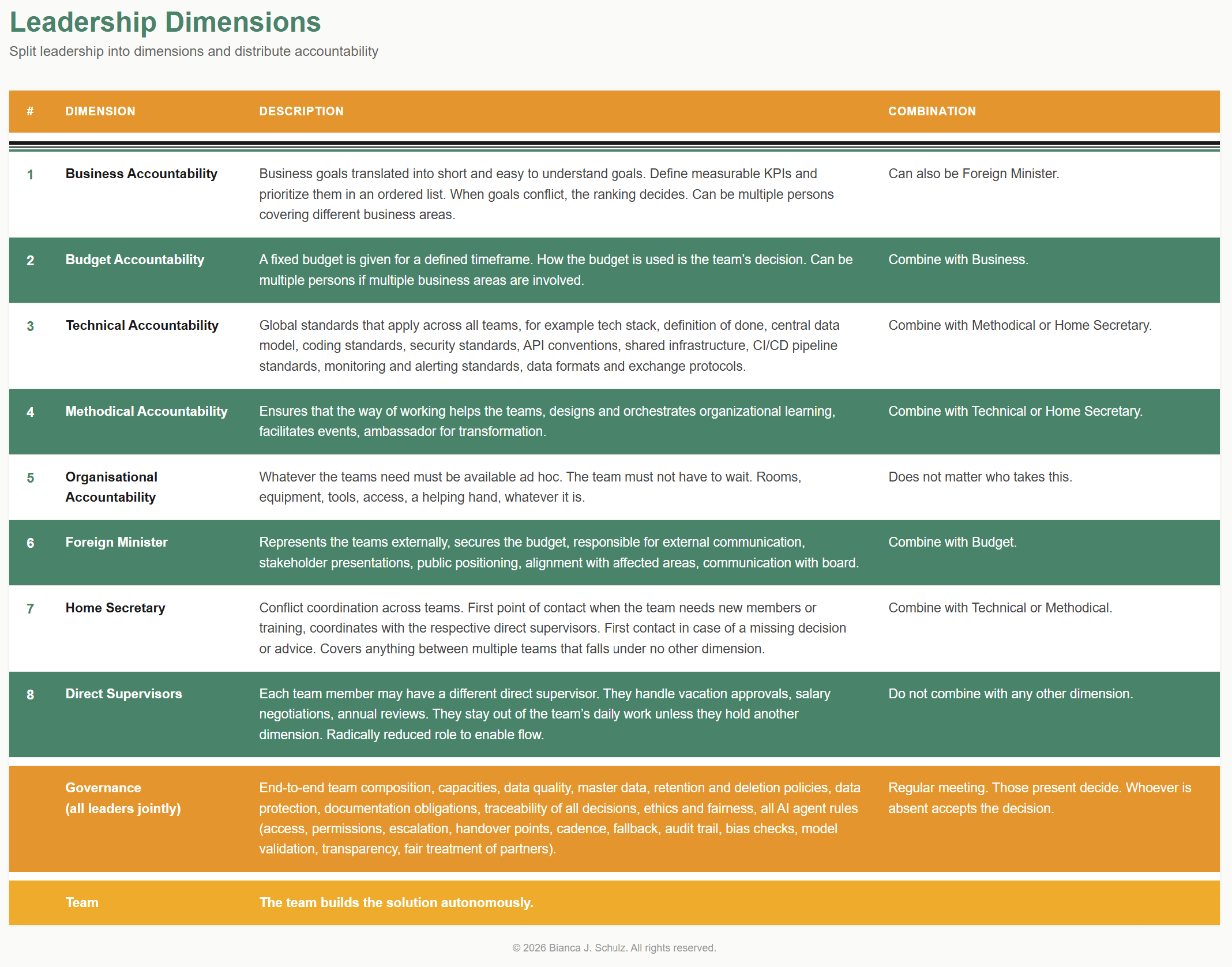
Take, for example, the following leadership dimensions: disciplinary, financial, strategic, technical, domain-related, methodological, organizational, and then all the different areas of governance. How many dimensions rest on few shoulders, and how many people coordinate without taking real responsibility for any one of these dimensions?
Once you untangle that properly, it quickly becomes clear why agile teams also need leadership teams. It has to be clearly settled who owns what, but it is impossible for one manager to own everything, otherwise they become the bottleneck. A team is also always able to decide when someone is absent.
In this workshop we look at an example from your company: an end-to-end process that delivers value for the customer, which delivery teams work on it, and who the leadership team is.
What you take away:
You understand how to shape your organization with simple means so that everyone works in the same direction: with cross-functional teams and leadership teams that jointly own the dimensions of leadership, which leadership dimensions would have to be distributed how, and who would be part of the leadership team. That takes load off managers and enables far faster decision-making.
Related workshops
Would you like to learn more about this workshop?
Learn more
The AI Operating Model Starts with Mindset
…and with how we think about people.
Read article →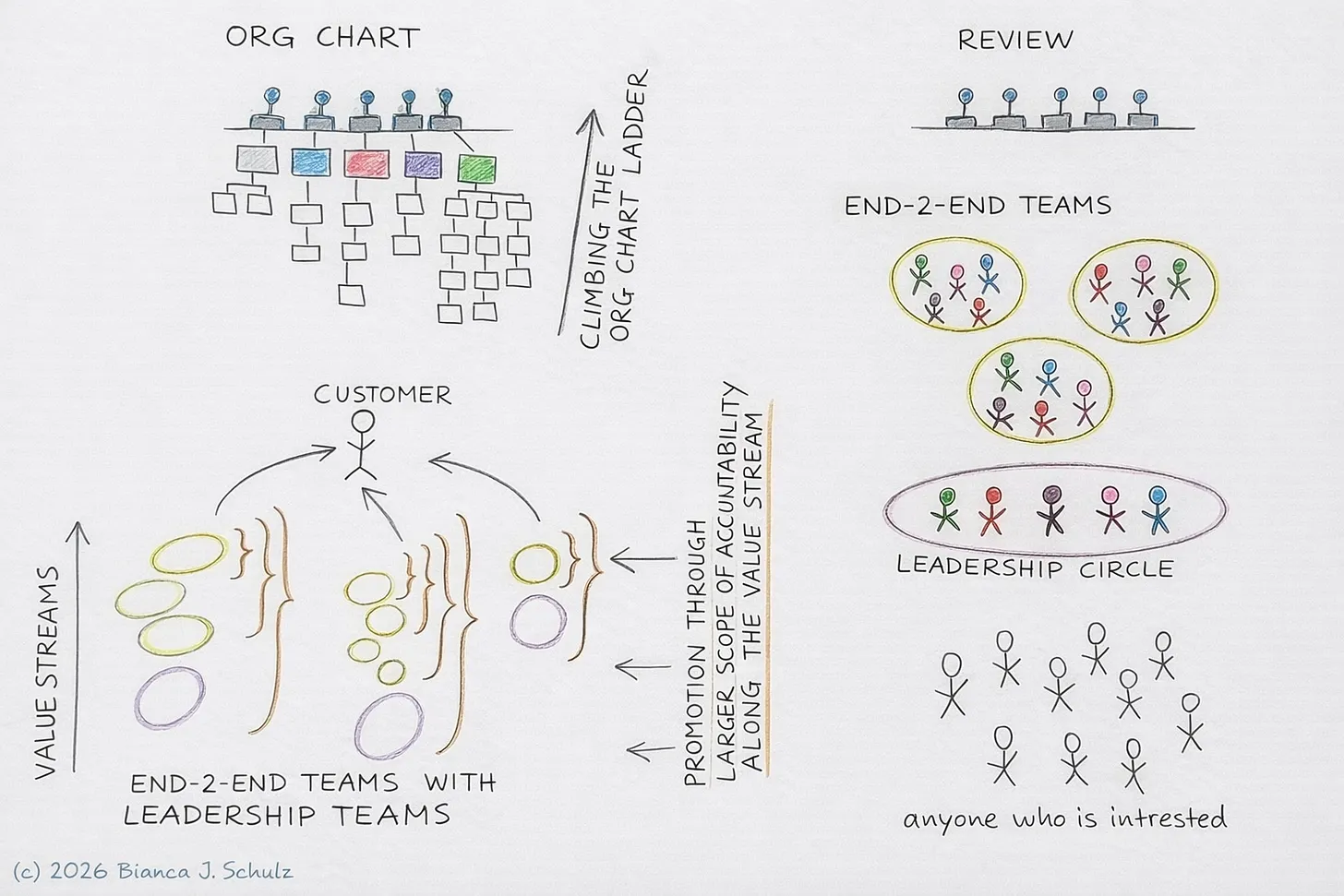
End-2-End Teams and a Leadership Team Along the Value Stream
End-2-end teams, leadership team rethought, career paths along the value stream
Read article →"AI transformation" is really the wrong word
It is always a transformation of the company — AI is merely the occasion, the enabler, the accelerator. What it looks like to start with the customer.
Read article →