Transformation Through Culture
At a glance
- Large-scale transformations that begin from a small nucleus – one that creates something people can recognize, feel, and join – are more likely to be successful.
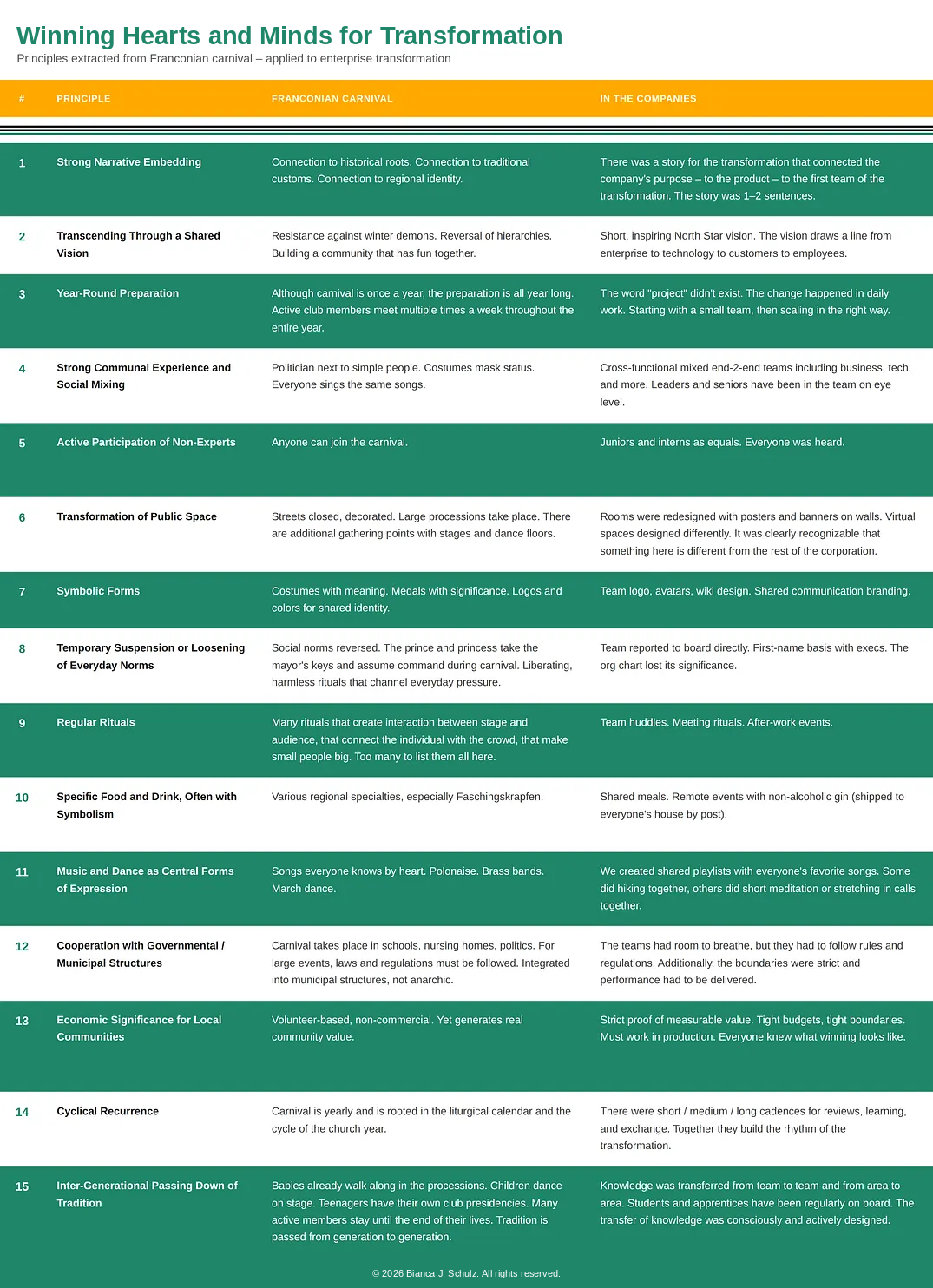
- What carries transformation is not a single lever, but a combination of elements, see the table below.
- Together, they create the conditions under which people begin to carry the change themselves.
- How the first team is set up and what boundaries are put in place is decisive.
- Through the work and the outcomes of the team, you learn how the organization needs to change. It happens through experience and learning, not through planning and strategy.
What does that look like in practice? In the companies where I saw this work, the pattern was always the same: A small group of people starts. External advice in small doses. The majority are internal. No frameworks imposed from above – principle-based work instead. That small group needs the magic spark. And from there, they build something new.
The organizational change that was firmly established years later grew out of hands-on experience with a small example that was then scaled up. Not top down. But from a grassroots movement.
Franconian carnival is a good example of how to win people over for a cause.
Instead of rushing to commit resources in the wrong places, I want to show you principles that help. In the large-scale transformations I was part of, these principles were applied. We didn't talk about carnival back then. But I think a good metaphor helps more than colorful strategy slides.
Here's what I'll do: First, the characteristics of Franconian carnival, abstracted. Then, a brief look at how these were applied in the companies. And after that, my interpretation.
The characteristics
I extracted them from personal observation, not from a paper or a book. This doesn't claim to be an academic paper. It's simply my personal observation. These may certainly apply to other cultures, too.
- Strong narrative embedding
- Transcending through a shared vision
- Year-round preparation
- Strong communal experience and social mixing
- Active participation of non-experts
- Transformation of public space
- Symbolic forms
- Temporary suspension of everyday norms
- Regular rituals
- Specific food and drink, often with symbolism
- Music and dance as central forms of expression
- Cooperation with governmental/municipal structures
- Economic significance for local communities
- Cyclical recurrence
- Inter-generational passing down of tradition
Here's an overview of what these elements look like in carnival and how they were lived in the companies: