The AI Operating Model Starts with Mindset
Everyone is talking about AI, about the new operating model, about the org chart and how it's a problem.
But none of these people are talking about our view of human nature and how we define success!
And that's a mistake.
First comes a mindset, and my inner world determines how I shape the outer world.
There can be no transformation, and nothing new can be created, without a new perspective on how we think about people, how we define leadership, and what we consider success.
But first: Why are so many people talking about a new, AI-driven operating model right now?
Starting Point: AI Agents Make Cross-Team Workflows the Norm
As soon as AI agents begin to support me in my work, I very quickly encounter a use case where work must happen across multiple teams or departments—which is only logical, as many workflows run across teams and departments.
This was true even before AI. There are also many organizations that recognized this early and therefore designed cross-functional teams along the value stream. But not all of them.
AI Amplifies
If silos exist and AI is deployed within them, AI amplifies the very problems that arise from them.
If your organization works cross-functionally along the value chain, AI amplifies the strengths you already have.
Your organizational structure determines whether AI helps you or harms you.
Many have already recognized and written about this.
What's missing is a look at what happens before that.
For this, we need to dive much deeper into the individual topics. This article is just an introduction. Each topic is only touched upon briefly to outline the field we need to enter.
The Obstacle: Politics and Power
Organizations vary greatly, and there are organizations where things get "political." Perhaps you've worked in such an organization before. I think everyone can relate to the term.
Dynamics arise when power is unequally distributed and when the interests of the various people in power are very different. These interests are then negotiated with each other.
The more freedom people with influence have to push their interests, the greater the dynamics and the more "political" it becomes.
This is not the fault of individuals. The system gives them this freedom and the incentive to act this way.
The core question: Why does nothing change, despite everything we know?
Everything I'm saying now is nothing new. It's all been known for a long time. So one has to ask: If we've already understood this, why don't we build organizations differently?
The Thesis: The View of Human Nature Determines the Design
Because our view of human nature doesn't allow for it.
In the large organizations where I've been involved in successful transformations, where the organization truly reshaped itself fundamentally, this was always the first thing that was clarified together.
How do we see people?
My inner picture determines how I shape the outer world.
Personal Development: Team Lead or Cross-Functional Work
If I believe that people need a team lead to show them how to develop personally, a team consisting exclusively of data people or engineers automatically emerges, and the team lead coaches these people and helps them develop.
If I have a completely different attitude towards people, namely that people develop best through cross-functional teamwork and that a team of leaders recognizes developmental potential in team members, then I am no longer dependent on functional team leads. Then I suddenly have much more room to build a completely different structure.
The Team as an Entry Point or a Career Setback
Do I think that working in a team is the beginning of a career and that a leader should no longer be a team member? Do I think teamwork is a kind of status loss for leaders?
Do I think teams are nothing more than a group of people who work on what they're told?
What deeper view of human nature lies behind this?
That people can't coordinate themselves within a team? That someone with more skills coordinates better?
Have I ever experienced real teamwork?
Many have to answer "no" because their organization holds a view of human nature that considers teamwork without a coordinating role impossible.
In this view of human nature, one person knows more than everyone else combined. One person can communicate better than everyone else combined. One person can decide better than everyone else combined.
Do you notice how much overestimation is inherent in this attitude?
People Adapt to the Attitude
People sense everything.
As soon as the prevailing view is that teams cannot achieve outstanding results without coordination by a leader, they unconsciously adapt and behave accordingly.
I have so often seen Data Engineers who knew exactly what was going wrong but, out of respect for leaders, only expressed their views subtly. Even in an environment where team members speak openly, the rule is: as soon as a leader makes a decision, the team cannot decide the opposite.
Very few organizations succeed in this balancing act between team and leadership decisions.
Control by Management or Self-Organization Through Guardrails
If I believe that people need other people to lead them because they won't do it right otherwise, then of course I need project managers or team leads or other leaders to ensure that who works on what is controlled.
But if my inner attitude is that people organize themselves much better as soon as the guardrails are clearly defined and kept very tight (what does winning look like?), then I have the freedom to build completely different structures.
But if I hold the view that this doesn't work because people are differently intelligent or differently capable and I have to place one above the other, then sooner or later I end up back with teams and departments.
Missing Principles
What principles do I have when it comes to power, responsibility, and success?
If you haven't formulated explicit principles for this, if you haven't developed your own opinion and attitude on the matter, you cannot build a healthy system—and I'll explain why.
Ambition and the Question of How We Define Success
Human ambition is something very positive, but it can also quickly turn negative. In sports, we admire performance. But also in other areas, the will to achieve something great has served humanity well.
Whether ambition benefits a system or makes it dysfunctional, however, depends on how we define success. If I define success through titles, money, and dominance, it will sooner or later tip, and ambition will work against the organization.
Because then something is missing to counteract it, a corrective or a strong counterforce. I can only establish this strong counter-pole if I have previously defined, formulated, and communicated the principles on which it is based. Principles are the foundation for the counterforce. A counterforce without the enforcement of consequences is a wish, not a force.
Human forces must be channeled into narrow paths. Too much freedom is anarchy and harms not only the organization but also creativity and innovation.
In an organization where you feel like you're in a shark tank, the individual's room for maneuver becomes smaller and smaller. Power dynamics narrow one's perspective. The greater the dynamics, the fewer design options I have.
Redefining Leadership and Distributing It Across Multiple Shoulders
To prevent dysfunctional power dynamics from arising, leadership must be redefined.
Leadership works best when I define different leadership dimensions, view them as separate from individuals, and then distribute them across different shoulders.
Disciplinary leadership must be completely rethought. Ideally, it is just an administrative function. This presupposes that my personal view of human nature is: People like to give their best.
If I believe that people are lazy and need to be monitored, I don't have this freedom of action.
The moment I question my view of human nature, I have more options for action and can decouple disciplinary leadership from the other leadership dimensions, thereby limiting power.
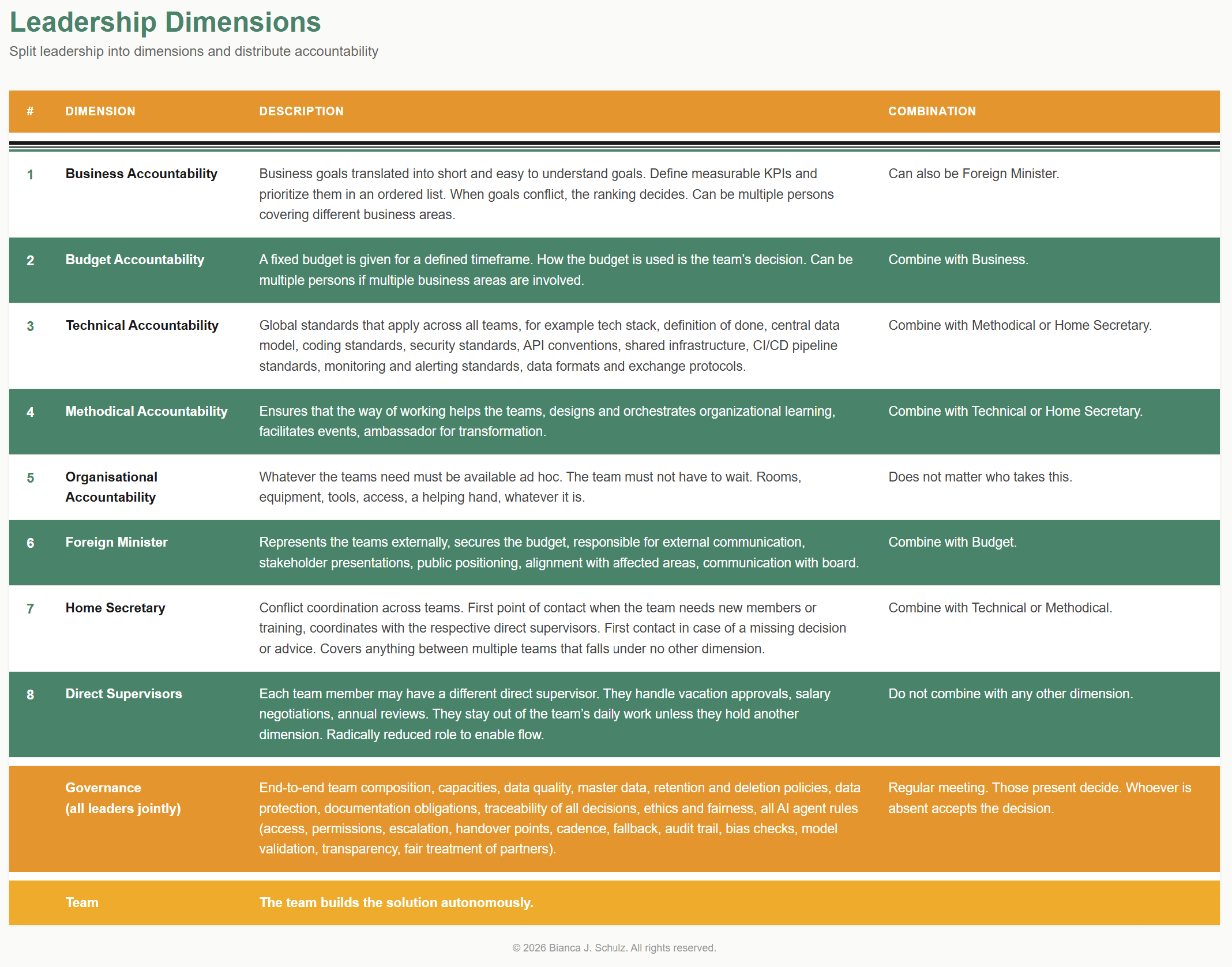
More on this in subsequent articles.
All consultants who are not willing to question power and leadership structures are cementing the status quo.
Those Who Question Their View of Human Nature Gain Design Possibilities
My inner attitude determines what I see and perceive. If I am willing to change my attitude, my horizon broadens, and completely new design possibilities open up.
Outlook
In the next articles, we must delve deeper into each topic touched upon here in order to understand it on a fundamental level.
You must form your own opinion on these topics. Only through reflection can the inner attitude be formed that gives you the strength to create a new operating model.
The great art is to translate theory into practice.
There are many thought leaders who have written similar things, but hardly anyone who also provides the tools to translate all of this into practice.
There are many helpful ideas and methods.
Some of them, like the Leadership Dimensions, I have developed myself, and many other people have also developed their own ideas.
What's missing is a curated collection. I will start an open-source project with my own methods and techniques. Later, others can also contribute their techniques and methods after they have been curated and approved.
The real challenge, however, lies in defining your own principles for your own organization and choosing the right method for your own situation to create an organizational design in which the new way of working with AI benefits the organization.